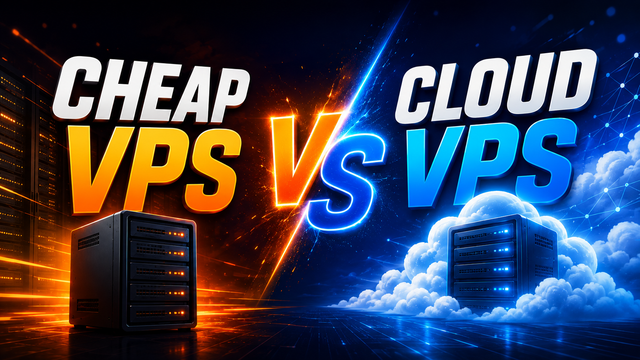
When evaluating the Return on Investment (ROI) between a Cheap VPS (Traditional/Single-Host VPS) and a Cloud VPS, the winner depends entirely on your project's revenue model, uptime requirements, and resource consumption patterns.
ROI is not just about the upfront monthly subscription cost—it measures Revenue Generated or Productivity Saved divided by Total Cost of Ownership (TCO).
Here is a detailed structural breakdown comparing both options to help you determine which architecture gives you a better return on investment.
A cheap VPS runs on a single physical host server that has been divided into smaller virtual instances using virtualization tools like OpenVZ, LXC, or KVM.
A Cloud VPS operates across a distributed cluster of interconnected physical servers backed by SAN/NVMe network storage.
| Operational Metric | Cheap VPS | Cloud VPS | ROI Advantage |
|---|---|---|---|
| Upfront Monthly Cost | Extremely Low ($2 to $10/mo) | Moderate to High ($10 to $50+/mo) | Cheap VPS (Short-term savings) |
| Downtime Financial Risk | High (Single server hardware failure = extended outage) | Ultra-Low (Auto-failover keeps services running) | Cloud VPS (Protects revenue) |
| Scalability Friction | High (Requires downtime or migration to upgrade) | Zero (Instant elasticity as traffic surges) | Cloud VPS (No lost sales during spikes) |
| Maintenance Overhead | High (Requires manual setup, backups, and tuning) | Low (Automated snapshots, API management) | Cloud VPS (Saves developer hours) |
| Performance Consistency | Low to Moderate (Prone to "noisy neighbor" throttling) | High (Guaranteed dedicated virtual resources) | Cloud VPS (Better user retention) |
You are running low-stakes environments where an occasional hour of downtime will not cause financial loss.
You are hosting production workloads, revenue-generating e-commerce sites, API backends, or real-time platforms where downtime directly costs money.
If you are looking for enterprise reliability without corporate cloud price inflation, choosing high-performance virtual infrastructure networks bridges the gap.
For example, platforms like CloudLaag offer isolated KVM-virtualized nodes backed by modern AMD EPYC processors, enterprise NVMe SSD arrays, and automated Always-On DDoS Protection. This gives developers and businesses isolated hardware resources, low-latency routing across India and global data centers, and enterprise protection at accessible price points.
Wednesday, July 1, 2026