Choosing an Indian Minecraft server host used to mean settling for oversold hardware, frequent stock outages, or high latency to offshore datacenters. As the Indian gaming landscape expands into 2026 and 2027, several local providers have emerged to offer domestic nodes.
Among the most discussed hosts are GB Node (GBNodes), Giga Node (GigaNodes), Lord Cloud, and CloudLaag. While all four target Indian Minecraft communities, differences in CPU architectures, storage tiers, noisy-neighbor isolation, and DDoS scrubbing determine which provider actually keeps your server at a stable 20.0 TPS.
GB Node is an established brand in the Indian gaming community with a solid customer base.
Giga Node has made aggressive moves with low entry-level price points.
Lord Cloud caters primarily to entry-level creators and budget-focused co-op players with cheap or free tiers.
| Infrastructure Metric | GB Node | Giga Node | Lord Cloud | CloudLaag |
|---|---|---|---|---|
| Processor Focus | AMD EPYC / Ryzen 9 | AMD EPYC / High-end VDS | Budget Multi-core | High-Frequency AMD EPYC & Ryzen |
| Storage Architecture | NVMe PCIe | NVMe SSD | Standard SSD / NVMe | Enterprise NVMe Arrays (Standard) |
| DDoS Mitigation | GBSHIELD / Magic Transit | Cloudflare Magic Transit | Basic Network Scrubbing | Multi-Tbps Always-On Edge Scrubbing |
| Panel Environment | Pterodactyl / Custom | GigaPanel (Pterodactyl fork) | Pterodactyl | Optimized Pterodactyl Panel |
| Domestic Ping (India) | Sub-30ms | Sub-30ms | Sub-40ms | Sub-25ms Pan-India Routing |
| Value / Scalability | Higher cost per GB | Scalable, but steep jumps | Budget-constrained | Balanced pricing with VPS elasticity |
While competitors focus on either high markups or aggressive overselling, CloudLaag balances high-frequency single-thread compute, unthrottled storage speed, and enterprise security at accessible price points.
Minecraft's core tick loop operates on a single execution thread. Running on high core-count processors with low clock speeds causes TPS drops as soon as players explore chunks or build farms. CloudLaag deploys high-frequency AMD EPYC and Ryzen hardware that guarantees fast tick cycles, keeping complex Paper, Purpur, or Fabric environments running at a clean 20.0 TPS.
Autosaves and rapid Elytra flight force continuous disk read and write operations. While budget hosts often throttle disk I/O, CloudLaag equips every gaming container with enterprise-grade NVMe SSD storage as a baseline standard. This completely eliminates save-lag, chunk render freezes, and world corruption risks during backups.
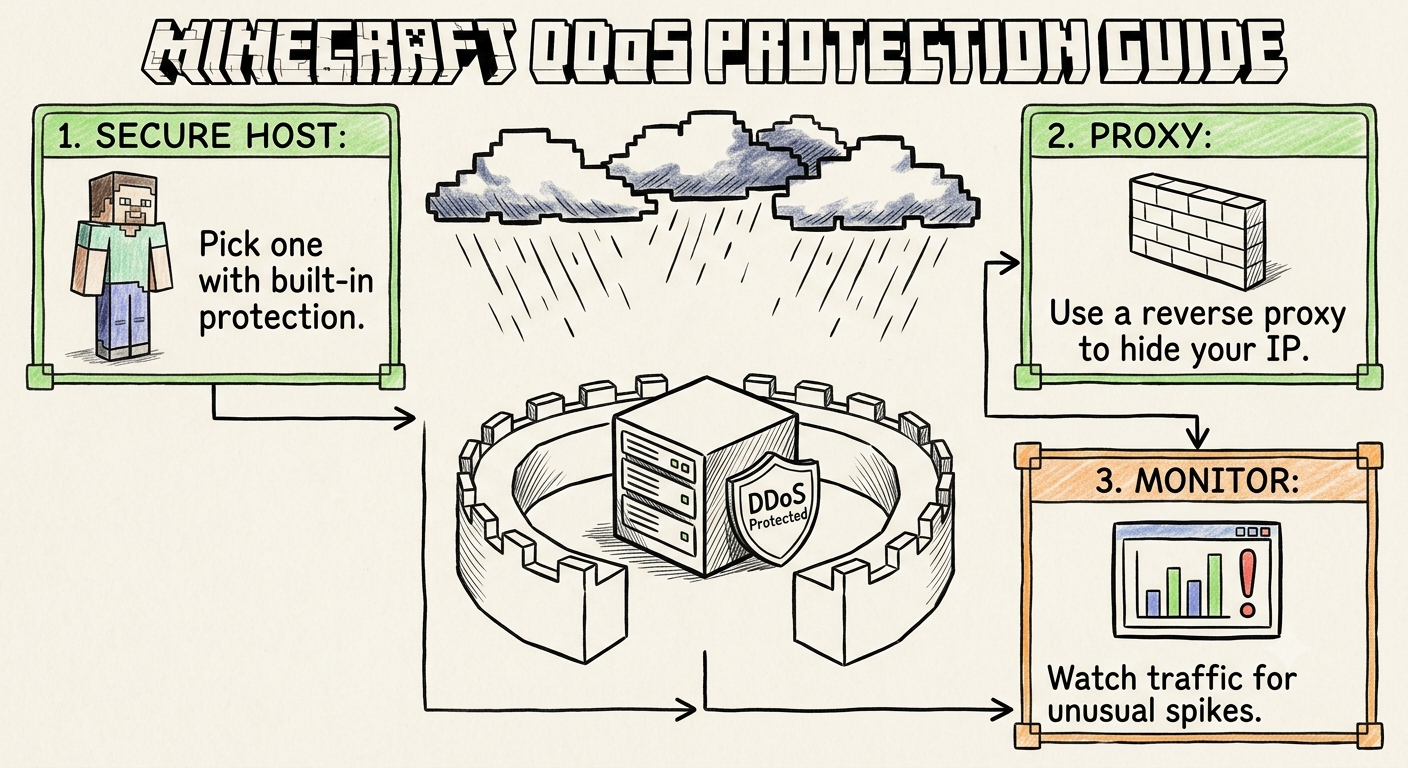
Minecraft servers in India face constant volumetric bot floods, exploit scanners, and UDP reflection attacks. Standard hosts often null-route or drop player connections during active floods to protect their primary nodes. CloudLaag provides automated, Always-On DDoS Protection engineered with protocol-aware edge scrubbers that filter out malicious packet floods before they ever touch your container, keeping your latency smooth during attacks.
A gaming community rarely stops at a single Minecraft server. With CloudLaag, you can host your primary world on optimized Minecraft hosting, deploy community automation on Discord hosting, run companion survival worlds on Palworld hosting, or migrate to a full root-access VPS hosting container—all managed from one unified platform.
- Pick the Right Engine: Upgrade from standard Vanilla to Paper or Purpur to leverage asynchronous chunk handling and entity tick management.
- Review Deployment Guides: Learn how to tune JVM startup flags and configure Pterodactyl schedules by reading verified guides inside official CloudLaag technical docs and developer wikis.
- Stay Updated on Hardware Trends: Explore optimization benchmarks and software recommendations on the CloudLaag network blog page.
Recommended for this article
Monday, July 13, 2026