Nothing ruins a growing Minecraft SMP or competitive Lifesteal launch faster than a targeted attack. One minute your community is playing at a smooth 20.0 TPS with 20ms ping, and the next minute everyone times out with Internal Exception: java.net.SocketException: Connection reset, or your console fills with thousands of fake accounts joining per second.
In 2026, launching a public server without specialized game-layer mitigation is nearly impossible. Cheap "booter" panels and automated botnet scripts allow rival server owners or angry banned players to launch gigabit-scale attacks for a few dollars.
More importantly, standard web hosting DDoS protection does not work for Minecraft.
Whether you are protecting a single Paper SMP or defending a multi-server Velocity network on CloudLaag, here is the complete technical breakdown of how Minecraft DDoS attacks work, why generic firewalls fail, and how to lock down your server against both bandwidth floods and Layer 7 bot attacks.
To block an attack effectively, you first need to understand what is actually hitting your server IP. Attacks against Minecraft servers fall into three distinct categories:
The attacker uses a network of infected devices (a botnet) to blast your server IP and port (25565) with millions of junk packets per second—such as UDP amplification, TCP SYN floods, or ACK floods.

Java Edition uses TCP (25565), which requires a verified 3-way handshake before data is processed. Bedrock Edition (and GeyserMC cross-play on port 19132) runs on UDP via the RakNet protocol. Because UDP is connectionless, attackers can easily spoof source IPs and flood port 19132 with malformed RakNet ping packets, overwhelming the server's network stack.
Instead of flooding your bandwidth pipe, Layer 7 attacks use real TCP connections via thousands of SOCKS4/SOCKS5 proxies to mimic real players.
Many server owners buy a cheap generic cloud VPS that advertises "Free DDoS Protection," only to get kicked offline during their first attack. Why? Because standard datacenter protection is built for websites (HTTP/HTTPS), not real-time game servers.
| Mitigation Factor | Generic Datacenter / Web DDoS Protection | Game-Aware Minecraft DDoS Mitigation (CloudLaag) |
|---|---|---|
| Traffic Detection | Triggers only after massive bandwidth spikes | Instant packet-level inspection on every handshake |
| Protocol Awareness | Understands HTTP/S (Port 80/443) only | Understands Minecraft TCP Handshakes & RakNet UDP |
| Mitigation Method | Often "Null-Routes" (Blackholes) your IP for 15 mins | Scrubs bad packets at the edge; keeps real players online |
| Latency Impact | Routes traffic to distant scrubbing centers (+100ms ping) | Local edge scrubbing maintains sub-25ms India ping |
| Bot Flood Defense | Ignores Layer 7 fake player connections | Drops malformed status pings & coordinates with Velocity |
| When a generic datacenter detects a 50 Gbps attack on your IP, its automated system often protects its own routers by null-routing (blackholing) your IP address—meaning it disconnects your server from the internet completely for 15 to 60 minutes. True game protection filters out the attack traffic while keeping legitimate players connected without dropping a single tick. |
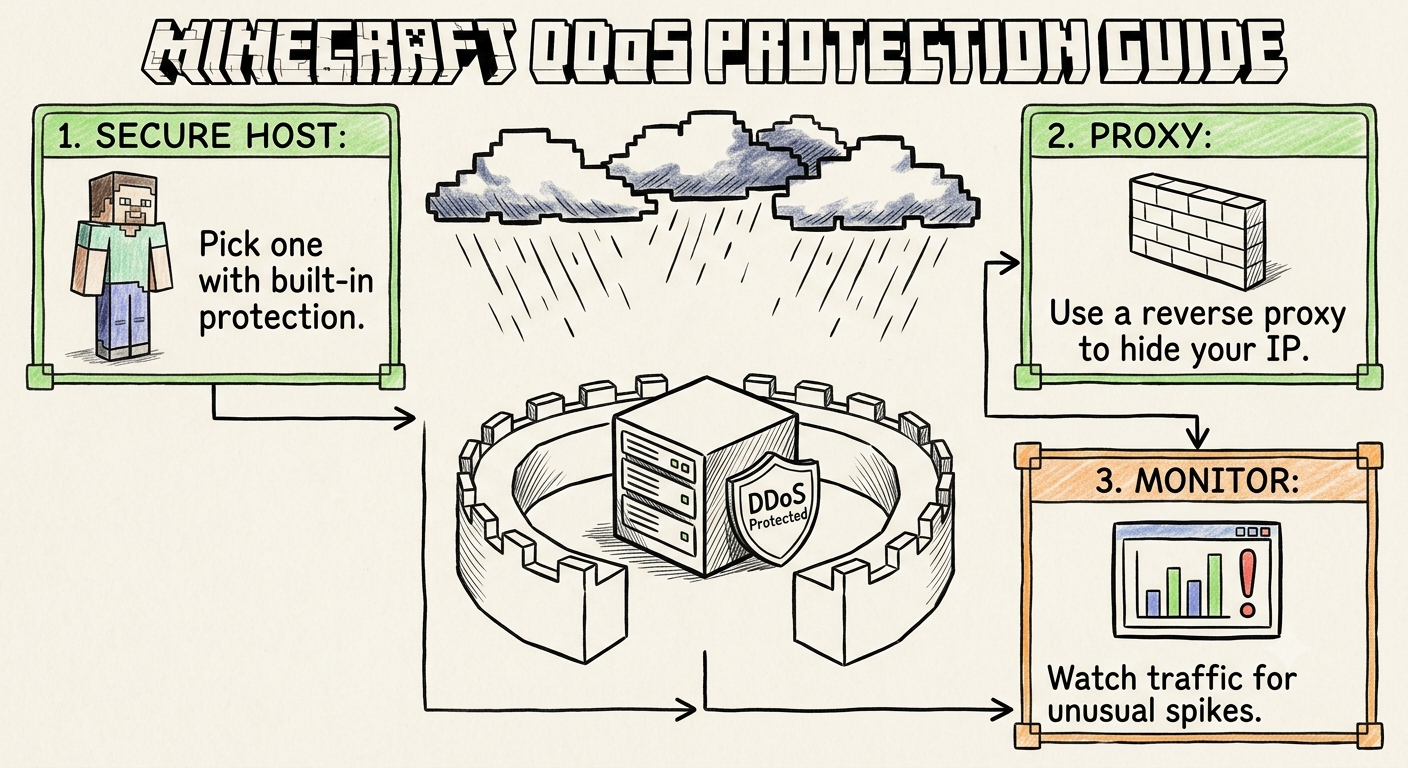
Securing a production Minecraft server requires combining network-level scrubbing with software-level hardening:
Your hosting provider must run stateful edge firewalls capable of inspecting Minecraft TCP handshakes and Geyser RakNet UDP packets at line rate. Any UDP packet hitting a TCP-only Java port, or any malformed SYN packet that fails handshake validation, is dropped at the router level before it ever reaches your server's CPU.
If you run a multi-server setup, never let players connect directly to your survival world's IP. Place a Velocity Proxy in front of your network and lock down your backend ports using UFW or IPTables so they only accept traffic from the Velocity IP. Even if an attacker discovers a way to spam connections, the lightweight proxy absorbs the hit while your main survival world stays untouched at 20.0 TPS.
Network firewalls block packet floods, but you need an application filter to stop proxy join-bots (especially on online-mode=false cracked servers).
Inside paper-global.yml, ensure packet-limiter is enabled to automatically kick clients that attempt to crash the server by spamming book-edit, recipe-book, or creative-slot packets.
You should not have to pay hundreds of dollars for third-party reverse proxies like TCPShield or lose 60ms of latency routing your Indian player base through European scrubbing centers just to stay online.
When you deploy your world on CloudLaag, enterprise Always-On DDoS Protection is engineered directly into the network edge across every Minecraft hosting plan and isolated VPS hosting container at zero extra cost.
Here is how CloudLaag keeps your server online under heavy fire:
- Never Leak Your Backend Node IP: If you use Cloudflare SRV records or custom domains, never point an unprotected subdomain (like direct.yourdomain.com) to your backend database or unprotected ports.
- Review Official Security Guides: Server administrators can copy verified UFW firewall rules, Sonar anti-bot configurations, and Velocity forwarding setups inside the official CloudLaag technical docs.
- Stay Ahead of New Exploits: Follow the latest patches for Netty crash exploits, log4j-style vulnerabilities, and network security benchmarks on the CloudLaag network blog page.
In 2026, DDoS protection is not an optional luxury—it is the foundation of your server's uptime and reputation. Stopping modern attacks requires two halves working together: Multi-Tbps Layer 3/4 edge scrubbing at the hosting level to stop bandwidth floods, and Velocity + Anti-Bot filtering (Layer 7) at the software level to block fake proxy joins.
By hosting your server on Minecraft infrastructure or an isolated VPS hosting node powered by CloudLaag, you get enterprise-grade Always-On DDoS mitigation, sub-25ms Indian routing, and high-frequency AMD compute—ensuring your community stays online at 20.0 TPS no matter what gets thrown at your IP.

Wednesday, July 1, 2026