Buying a Minecraft server should be exciting, not a technical headache. Yet every day, hundreds of server owners fall for flashy marketing banners promising "Unlimited RAM for ₹99" or "100 Player Slots Guaranteed"—only to launch their SMP and watch the server choke at 11.0 TPS the moment five players fly in different directions.
Why does this happen? Because most hosting buyers only look at the RAM count and the monthly price tag, completely ignoring the underlying hardware specifications that actually keep a Minecraft server lag-free.
Whether you are starting a cozy survival world with friends, launching a heavy 300+ modpack, or scaling a public Lifesteal network on CloudLaag, here are the 7 non-negotiable technical specs you must check before spending a single rupee on Minecraft server hosting in 2026.
Use this cheat sheet to instantly spot the difference between an oversold budget host and enterprise-grade game infrastructure:
| Hardware / Network Spec | Red Flag (Avoid These Hosts) | Green Flag (What You Actually Need) |
|---|---|---|
| CPU Model Disclosure | Hidden ("Enterprise vCPU" or old Intel Xeon) | Explicitly named (AMD Ryzen 9 / High-Freq EPYC) |
| Single-Core Clock Speed | Under 3.2 GHz (Causes severe tick lag) | 4.0 GHz to 5.0+ GHz Turbo Clock |
| Storage Drive Type | Standard SSD or SATA SSD | Enterprise PCIe NVMe SSD Arrays |
| Server Location (Ping) | Offshore Singapore/Europe (70ms–140ms) | Domestic India Nodes — Mumbai/Delhi (Sub-25ms) |
| RAM Allocation Policy | "Unlimited RAM" or heavy Swap usage | Dedicated DDR4/DDR5 RAM (Zero Swap Thrashing) |
| DDoS Mitigation | Basic Web Firewall (Null-routes your IP) | Always-On Game-Aware L3/L4/L7 Scrubbing |
| Control Panel | Laggy custom panels with locked files | Modern Pterodactyl Panel + Full SFTP Access |
The biggest secret in the hosting industry is that Minecraft cares far more about CPU speed than RAM. Because Minecraft’s main game loop (entities, mob AI, redstone, and combat) runs primarily on a single CPU thread, every game tick must finish calculating within 50 milliseconds to maintain 20.0 TPS.
In physical computer hardware, there is no such thing as "unlimited" memory.
Every time a player flies with an Elytra, sails across an ocean, or enters a Nether portal, your server reads and writes thousands of region chunk files (.mca).
Many international hosts advertise "Asia Hosting" to Indian players, but their physical servers sit in Singapore, Tokyo, or Frankfurt.
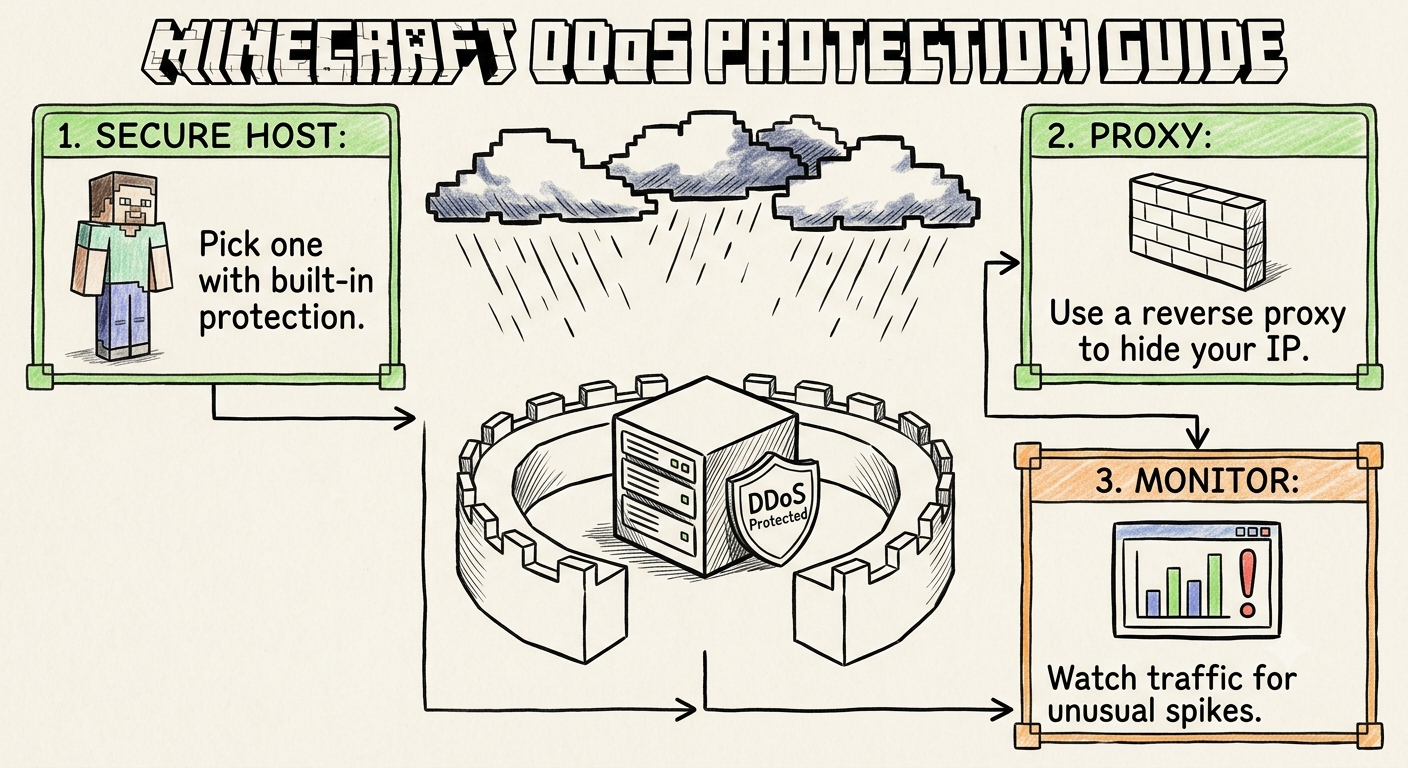
The moment your SMP grows popular, an angry banned player or rival server owner will inevitably test your IP with a bot attack or UDP flood.
Your hosting dashboard shouldn't restrict how you build your world. Before buying, confirm the control panel includes:
Communities grow fast. You might start a private SMP on a 6 GB plan on Friday and suddenly have 25 players trying to join by Sunday. Make sure your host supports instant in-place resource upgrades—allowing you to scale RAM and CPU cores up or down in clicks without changing your server IP or migrating files manually.
Instead of hiding hardware specs behind vague marketing buzzwords, CloudLaag engineered its entire platform around the exact checklist above—giving Indian server owners transparent, unthrottled performance from day one.
When you launch a server on CloudLaag's Minecraft hosting or deploy an isolated VPS hosting node, you get:
- Test Before You Commit: Always test a host's network routing and inspect their panel responsiveness.
- Read Official Setup Documentation: Check out pre-configured Aikar JVM flags, GeyserMC cross-play setups, and optimization guides inside the official CloudLaag technical docs.
- Compare Real Benchmarks: Stay informed on server engine comparisons, RAM calculators, and hardware reviews by exploring the CloudLaag network blog page.
Before buying Minecraft server hosting, look past the cheap price tags and "unlimited" promises. Verify the CPU clock speed, demand pure NVMe SSD storage, verify local Indian ping, and ensure Always-On game DDoS protection is included out of the box.
By launching your world on Minecraft infrastructure powered by CloudLaag, you check every single box on the pro buyer's checklist—giving your community a rock-solid 20.0 TPS experience with zero hidden bottlenecks.
Recommended for this article
Wednesday, July 15, 2026