Choosing the right Minecraft hosting in India is the single most important decision you will make as a server owner. Poor hosting creates cascading problems: lag that drives players away, corrupted worlds that destroy months of progress, downtime that damages your reputation, and support that abandons you during emergencies.
Yet many Indian server owners default to cheap international hosting simply because they do not know what to look for or what exists locally. They suffer high ping, poor support, and oversold resources, assuming this is the standard. It is not.
This guide covers everything you need to know about selecting Minecraft hosting in India: what features genuinely matter, what separates quality from budget providers, and how to evaluate options like a professional. We will also look at how leading providers stack up when measured by performance, reliability, and value.
Building on a budget vps? Minecraft servers are uniquely demanding. Unlike static websites or traditional applications, Minecraft servers must handle real-time physics, collision detection, entity processing, and player synchronization happening simultaneously across potentially hundreds of players. A single frame drop cascades into chain reactions: entities rubber-band, blocks refuse to break, and combat becomes unplayable.
This means Minecraft hosting requires specifications optimized for a completely different workload than generic cloud hosting. A provider might offer impressive specs for WordPress sites or Discord bots, but completely misunderstand what makes Minecraft servers happy.
Latency is the most noticeable factor to players. A server in London with perfect uptime will feel worse than a mediocre server in Mumbai with 30ms ping. For Indian communities, this makes local hosting a non-negotiable requirement.
The physics of data transmission means latency cannot be negotiated away. A player in Mumbai trying to connect to a German server travels through multiple undersea cables, peering agreements, and international gateways. Each hop adds latency. A proper Indian hosting provider should have nodes within India, specifically serving Indian ISPs like Jio, Airtel, and ACT with optimized routing paths.
Storage speed directly impacts how quickly your world loads and saves. This is where budget hosting reveals its limitations most obviously.
HDD (Hard Disk Drives): 5,400-7,200 RPM mechanical drives offer massive capacity but terrible latency. A single chunk load can take 200-500ms. During server start, when loading player spawn regions, the server hangs for minutes. Never accept HDD storage for Minecraft.
SATA SSD: Mechanical reliability improved with sequential read speeds of 400-600 MB/s. This sounds impressive until you realize Minecraft does not use sequential I/O. Random access latency matters, and SATA drives deliver 15-25ms latency on random reads. Budget and mid-tier hosts often claim "SSD" meaning SATA, not the modern NVMe standard.
NVMe SSD: True modern storage with 0.1-1ms latency and 3,000-7,000 MB/s throughput. On NVMe, a chunk loads in 5-10ms instead of 500ms. Server starts are 50-100x faster. NVMe storage is the minimum acceptable standard for Minecraft hosting today.
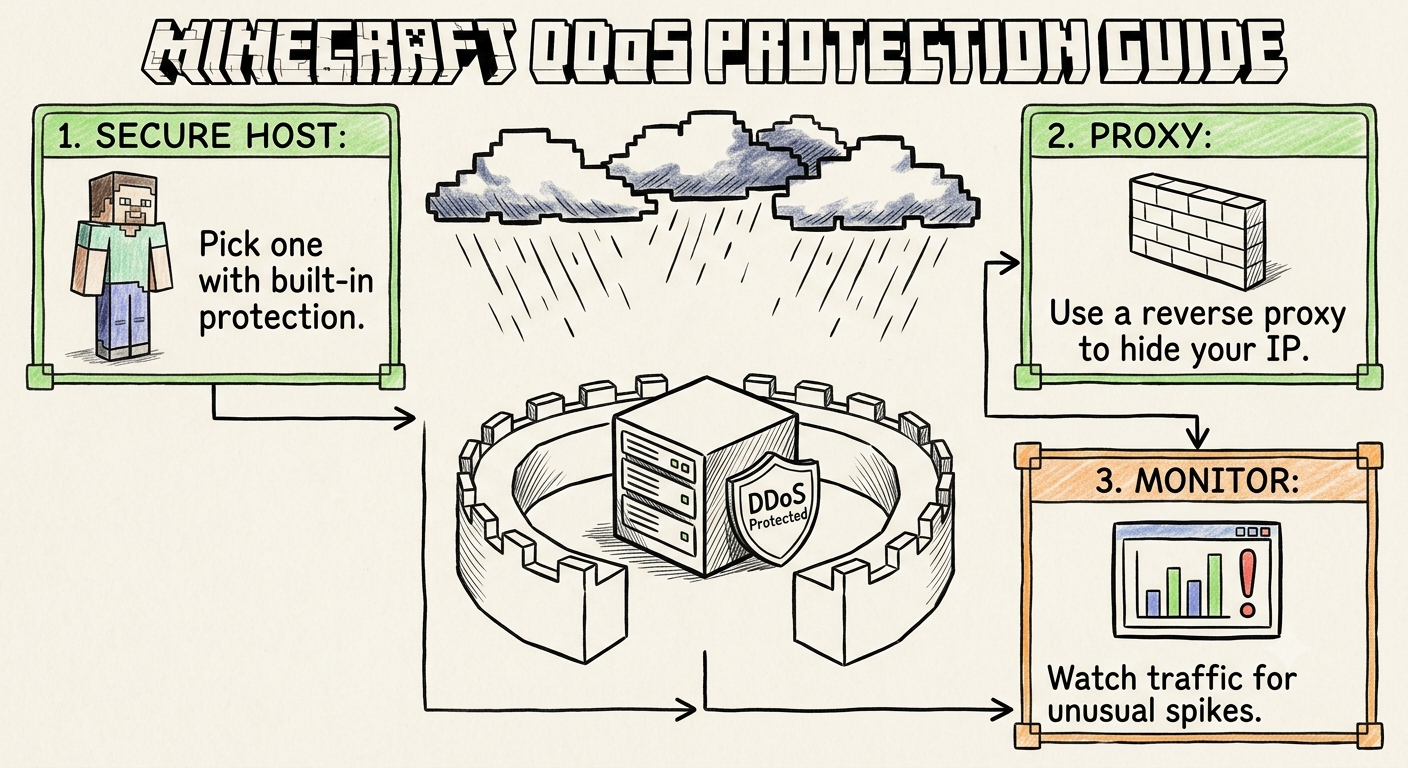
Budget hosts often market "DDoS protection" as a marketing buzzword. In reality, it means a basic rate-limiting firewall rule that crumbles under any real attack. Enterprise-grade DDoS protection requires multi-layer detection and mitigation:
This is where most Minecraft hosts disappoint. They list generic "Intel Xeon" or "AMD CPU" without specifying generation or clock speed. A decade-old Xeon E5 clocked at 2.0GHz performs radically different from a modern Ryzen 9 at 4.5GHz, but you would not know from marketing materials.
For Minecraft, the ranking matters:
Let us evaluate how major providers stack up against these criteria. This is not a ranking of marketing claims, but actual technical specifications and real-world performance.
| Feature | CloudLaag | GBNodes | GigaNodes | LordCloud |
|---|---|---|---|---|
| Server Location (India) | Available | Available | Available | Available |
| Storage Technology | NVMe SSD | NVMe SSD | NVMe SSD | NVMe SSD |
| CPU Model | Ryzen 9 5900X / EPYC 4th Gen | AMD EPYC & Ryzen 9 | AMD EPYC | AMD EPYC |
| DDoS Protection | 10 Tbps enterprise‑grade DDoS migration technology | GBSHIELD - Limited | Good DDoS Security | Good DDoS Security |
| Backup Strategy | Cloud Encrypted Off-Site (Multi-location Storage) | Normal Backups | Normal Backups | Normal Backups |
| Support Community | Discord, Site, Mail & Call - 24/7 | Discord & Mail | Discord & Mail | Discord & Mail |
| Price Range | ₹149 - ₹259/month | ₹399+/month | ₹299+/month | ₹180/month |
| Value (Performance/Price) |
Providers like LordCloud offer plans starting at ₹180/month, making them tempting for beginners. But this pricing reveals the problem, not solves it. No legitimate hosting provider can deliver real infrastructure at ₹180/month while maintaining profitability. What you are actually getting:
The real cost: You save ₹500/month upfront, but lose players to lag, corrupt a world and spend 48 hours rebuilding, get no support when it fails, and within 3 months, migrate to a real provider anyway. Your total cost is the same, but with stress, frustration, and damaged reputation included.
Providers like GBNodes and GigaNodes charge ₹2,500+ for entry-level plans. At this price point, you are paying for infrastructure you might not need. These providers often target large networks and enterprise clients who need premium support and custom configurations.
GBNodes' proxy server offerings come with a significant hidden cost: mandatory platform lock-in. If you purchase their proxy server, you are required to run 80% of your backend network exclusively on GBNodes' platform. This is not optional-failure to comply results in proxy suspension and your funds are not refunded to your bank account. Instead, you receive a credit that can only be used for GBNodes services.
This creates a trap where you cannot manage your own infrastructure independently. You are forced to depend entirely on their platform, limiting your technical choices and ability to migrate. If you disagree with their policies or service quality later, you cannot simply move your network elsewhere-your money is locked in their ecosystem.
For most Minecraft communities, this level of spending combined with platform lock-in is unacceptable. You get excellent hardware on paper, but at the cost of complete operational freedom.
CloudLaag occupies a unique position in the Indian market. It delivers enterprise-grade infrastructure at mid-tier pricing, specifically designed for Minecraft communities in India. Let us break down why:
All CloudLaag plans include NVMe SSD storage, enterprise DDoS protection (up to 10Tbps), automated backups on separate cloud storage, Pterodactyl Game Panel, and 24/7 expert support in Hindi and English.
Compare this to GBNodes (₹799+ entry) or GigaNodes (₹899+ entry) with identical hardware. CloudLaag's advantage is not just price; it is transparent value. You are paying for infrastructure, not marketing or premium support tiers you do not need.
The best hosting is worthless if setup is painful. CloudLaag includes the Pterodactyl Game Panel, an open-source dashboard designed specifically for Minecraft management.
What is the minimum RAM I need for a Minecraft server in India?
For vanilla or light plugin servers with 10–15 players, 2GB is sufficient. For larger communities (20–40 players) with moderate plugins, 4GB is the sweet spot. Modded servers need at least 4GB even for small groups because mod operations are memory-intensive. If your server TPS drops below 18, RAM is usually not the bottleneck—storage speed or CPU is.
Why does CloudLaag cost less than GBNodes and GigaNodes?
CloudLaag specializes exclusively in Minecraft hosting, while competitors like GBNodes and GigaNodes offer game server hosting across dozens of games. Specialization allows CloudLaag to optimize infrastructure specifically for Minecraft workloads, reducing overhead costs. Additionally, CloudLaag targets the Indian market directly, avoiding expensive international support and marketing costs. The savings are passed to customers.
Is SATA SSD storage acceptable for Minecraft?
SATA SSD works, but it is noticeably slower than NVMe. Chunk loading, world saves, and backup transfers all take 2–5x longer. For a 10-player server, you might not notice. For 40+ players, the delay becomes frustrating. Given that CloudLaag includes NVMe standard while competitors charge extra for it, NVMe is the clear choice today.
Can I upgrade my server without downtime?
Yes. RAM and CPU upgrades apply immediately through the control panel without migration or file transfer. The only downtime is a brief server restart when you initiate the upgrade, which you control. Traditional hosts require manual migration to a new machine, which takes hours and is error-prone.
What happens if my server gets DDoS attacked?
's multi-layer DDoS protection absorbs the attack at the network edge before it reaches your server. Your real server IP is hidden behind a protective proxy entirely. Most attacks finish in minutes, and your server stays online throughout. You receive alerts but no service interruption.
Can I run multiple servers on one account?
Yes. You can create as many servers as you want, limited only by your allocated resources. A ₹499 plan gives you 4GB RAM total, which you can split across multiple servers. Many communities run a lobby server (1GB), creative server (2GB), and survival server (1GB) on a single account. Manage all of them from one panel.
How often are backups taken?
Backups run daily at a fixed time (configurable per server). You can manually trigger additional backups anytime through the panel. Backup files are encrypted and transferred off-site immediately. You can download any backup and restore within minutes, or request support to restore a backup directly to your server.
The Minecraft hosting market in India has improved dramatically over the past two years. Quality infrastructure is now accessible at reasonable prices, not just to large networks but to small communities and first-time server owners.
CloudLaag represents the best combination of performance, reliability, affordability, and local support available in India today. Its infrastructure is built for Minecraft specifically, not adapted from generic game hosting. Its pricing is transparent, with no hidden fees at renewal. Its support understands Minecraft communities because it is built by them.
Whether you are launching your first SMP with friends, scaling a public server to hundreds of players, or building a multi-server network with regional nodes, CloudLaag provides the foundation you need.
Ready to experience the difference that purpose-built Minecraft hosting makes? Start your free trial or explore plans at CloudLaag's Minecraft hosting page. Set up your first server in under 5 minutes and see how instant NVMe storage, low-latency routing, and enterprise DDoS protection transform your server experience.
Your community deserves hosting infrastructure as reliable as the worlds you build together.
Recommended for this article
| Best Performance & Affordable |
| Very Expensive |
| Expensive |
| Very Cheap |
Wednesday, July 15, 2026